My research reckons with the Civil War’s intertwined social, cultural, and health consequences in the 19th and early-20th-century United States. I’m interested in uncovering the intimate personal costs of the war for survivors that added up to unexpected, broader changes in postwar America. When the war’s carnage shattered survivors’ bodies and ruined their health, it upended deeply-rooted social norms and cultural ideals. Postwar Americans were left to sort out these complex legacies.
(Scroll for a comprehensive list of publications)
Books and Academic Writing
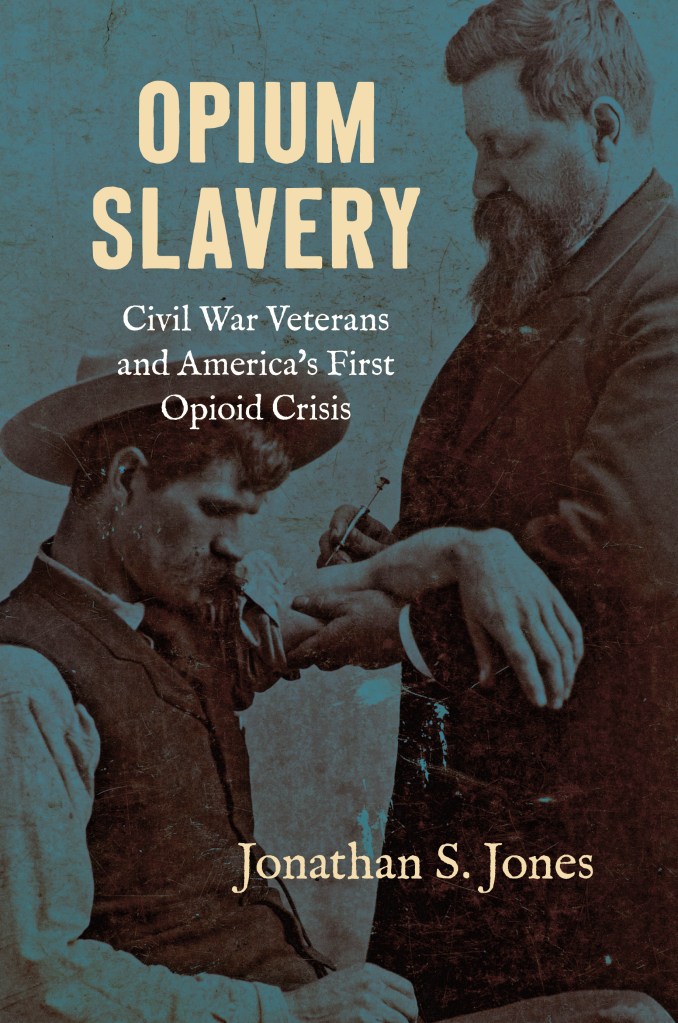
My first book, Opium Slavery: Civil War Veterans and America’s First Opioid Crisis (UNC Press, 2025) uncovers the hidden history of an opioid addiction epidemic that plagued veterans in the aftermath of the Civil War. Employing the approaches of gender, social, and medical history, Opium Slavery investigates the surprising causes and tragic consequences of addiction for Civil War veterans and their families. It also explores the radical responses by the American medical community and government authorities to the veterans’ addiction crisis. I’ve also published on the subject of opiate addiction in the nineteenth century in academic journals including Journal of the Civil War Era (June 2020), North Carolina Historical Review (July 2021), and Register of the Kentucky Historical Society (Summer/Autumn 2024), among other outlets.
I am the co-editor (with Joseph M. Beilein Jr. and Megan L. Bever) of “The Substances of War: Drugs, Alcohol, and Medicine in the Civil War Era” (under contract with UGA Press). The volume explores the intertwined history of substances–alcohol, opiates, tobacco, coffee, and more–during the Civil War era. Showcasing the centrality of substance use to the Civil War, the volume is the first to put multiple substances in conversation during the war.

My next book project, tentatively titled “Great American Frauds: The Civil War and the Development of Medical Capitalism, 1861-1914” (under advance contract with UNC Press), investigates several notorious, but forgotten cases of medical fraud committed by Civil War veterans against other veterans in the postwar decades. These epic frauds, I argue, illuminate how the healthcare demands of millions of sick and injured Civil War survivors overtaxed and ultimately transformed American medicine in the Gilded Age. To meet the surge in medical demand, entrepreneurial medical capitalists, including patent medicine sellers and pension lawyers, clashed with established physicians in an all-out battle for profit and professional power. This is a story of sick, desperate old soldiers, savvy and unscrupulous con-artists, and beleaguered, outmatched physicians, scientists, and sanitarians. It’s also a story of change over time, in which the Civil War’s medical frauds provide unique insight into the maturation of American medicine into a capitalistic enterprise during the late 19th century. This history has surprising and disturbing relevance in today’s internet age, when wellness influencers, anti-vaxxers, and scam artists peddle miracle cures and medical disinformation on social media and in the halls of power, reaping huge profits and challenging the authority of established medical professions.
My research has been supported by a postdoc from The Pennsylvania State University’s George and Ann Richards Civil War Era Center, and fellowships and grants from The Huntington Library, Yale University, The University of North Carolina at Chapel Hill, Duke University, William & Mary, the Consortium for History of Science, Technology and Medicine, The College of Physicians of Philadelphia, Virginia Historical Society, Kentucky Historical Society, New-York Historical Society, the New York State Archives, and the North Caroliniana Society, in addition to competitive grants and fellowships from Binghamton University, Virginia Military Institute, and James Madison University. In 2021, my dissertation received the Anne J. Bailey Dissertation Award from the Society of Civil War Historians, the inaugural Chancellor Distinguished PhD Graduate Dissertation Award from SUNY, and Binghamton University’s Distinguished Dissertation Award in 2020. The dissertation was also a finalist for the 2021 C. Vann Woodward Prize from the Southern Historical Association.
Public Writing
I’m committed to producing accessible writing on flashpoint historical topics for public audiences. Like the sciences, historical research can be difficult to translate for readers unfamiliar with historians’ lingo and methodologies. I aim to break down these access barriers for public audiences, with the ultimate goal of fostering historically informed conversations about current events, politics, and public policy.
Some of my favorite popular pieces explore the portrayal of slavery and Jim Crow in Red Dead Redemption 2 for Slate, the history of white supremacist violence by the Texas Rangers for the Washington Post, and the history of Civil War America’s opioid crisis for Vice. My research on the history of opioid addiction has also aired on C-SPAN and NPR, featured in the Washington Post, HISTORY, and BBC, and spotlighted by podcasts like History Hack and The Rogue Historian.

Publications
Books
(in progress) “The Substances of War: Drugs, Alcohol, and Medicine in the Civil War Era,” co-edited with Joseph M. Beilein Jr. and Megan L. Bever (under contract with UGA Press)
(in progress) “A Great American Fraud: The Civil War and the Development of Medical Capitalism, 1861-1914” (under contract with University of North Carolina Press)
Peer-Reviewed Journal Articles and Book Chapters
“Died from eating too much morphine”: Researching Opioid Use in Civil War-Era Appalachia,” Register of the Kentucky Historical Society 122, no. 3&4 (Summer/Autumn 2024): 341-374 (read here)
“‘Still Raging in These Fools’ Minds’: Civil War Memory in Red Dead Redemption 2,” in Playing at War: Identity & Memory in American Civil War Video Games, ed. Patrick A. Lewis and James Welborn, (under contract with Louisiana State University Press, forthcoming 2024) (buy here)
“The Life and Death of Frank Clewell, Confederate Veteran: Microhistory and the Civil War-Era South,” North Carolina Historical Review 98, no. 3 (July 2021): 249-282 (read here)
“Race and Opioids: Lessons From the Civil War-Era Opioid Addiction Crisis,” Psychiatric Times 38, no. 6 (June, 2021): 41-2 (read here)
“Buying and Selling Masculinity: Civil War Veterans and Opiate Addiction Patent Cures,” in Buying and Selling Civil War Memory in Gilded Age America, ed. Caroline E. Janney and James Marten (Athens, GA: University of Georgia Press, 2021), 31-47 (buy here)
“Opium Slavery: Civil War Veterans and Opiate Addiction,” The Journal of the Civil War Era 10, no. 2 (June 2020): 185-212 (read here)
Digital History
Principle Investigator, Locating Slaveries Legacies at VMI, 2022-24
“Red Dead Redemption 2,” Journal of American History 108, No. 3 (December 2021): 676–679, https://doi.org/10.1093/jahist/jaab343
Magazines & Newspapers
“The Civil War’s Miracle Drugs,” The Civil War Monitor, September 2, 2024
“The Civil War’s Epidemics,” The Civil War Monitor, June 17, 2024
“How to Use ChatGPT in the History Classroom,” Intersections 6, no. 3 (2023): 23
“Slavery, Racism, and Opioid Addiction in the Nineteenth Century United States,” The American Historian, Organization of American Historians (Fall 2023)
“Students Critique a ChatGPT Essay: A Classroom Experiment,” Perspectives Daily, American Historical Association, September 7, 2023
“Russia is suffering from the same problems that doomed the Confederacy,” Washington Post, October 21, 2022
“Covid-19 had killed more Americans than the Civil War. How do we remember them?” Washington Post, December 2, 2021
“America’s Forgotten History of Supervised Opioid Injection,” Undark Magazine, April 29, 2021
“Lessons learned — and forgotten — from the horrific epidemics of the U.S. Civil War,” STAT, April 18, 2021
“America Has Been Through an Opioid Crisis Before,” Vice, April 9, 2021
“Though often mythologized, the Texas Rangers have an ugly history of brutality,” Washington Post, September 21, 2020
“Opiate Addiction in the Civil War’s Aftermath,” Virginia History and Culture 7 (Spring/Summer 2020): 18-21
“Gov. Cuomo is wrong, covid-19 is anything but an equalizer,” Washington Post, April 5, 2020, co-authored with Bethany L. Jones
“Purdue Pharma taps a Gilded Age history of pharmaceutical fraud,” The Conversation, March 4, 2019
“Red Dead Redemption 2 Confronts the U.S.’s Racist Past and Lets You Do Something About It,” Slate, February 4, 2019
“Then and Now: How Civil War-Era Doctors Responded to Their Own Opiate Epidemic,” The Civil War Monitor, November 3, 2017
“The ‘Right’ and ‘Wrong’ Kind of Addict: Iatrogenic Opioid Addiction in Historical Context,” Nursing Clio, July 25, 2017
“Invisible Wounds: PTSD, the Civil War and Those Who ‘Remained and Suffered,’” WSKG, February 12, 2016
Scholarly Blogs
“There Has Always Been a Thin Line Separating the United States’ Jails and its Mental Healthcare System,”Clio and the Contemporary, January 10, 2021
“The ‘Great Risk’ of ‘Opium Eating’: How Civil War-Era Doctors Reacted to Prescription Opioid Addiction,” Medical History Library, Harvey Cushing/John Hay Whitney Medical Library, Yale University, December 1, 2020
“Drugs and Digitization: Investigating Opiate Addiction in the U.S. Civil War Era in the Age of Mass Digitization,”Points: The Blog of the Alcohol & Drugs History Society, November 10, 2020
“The ‘Worst Species of Inebriety’: Opiate Addiction in Antebellum New York City,”Gotham: A Blog for Scholars of New York City History, March 12, 2019
“Gilded Age Cures for Soldiers Suffering from Opiate Addiction,” The Devil’s Tale: Dispatches from the David M. Rubenstein Rare Book & Manuscript Library, February 20, 2019
“Elusive Consensus? War Trauma and the American Civil War at the Southern 2018,” H-CivWar, November 26, 2018
“‘A Mind Prostrate’: Physicians, Opiates, and Insanity in the Civil War’s Aftermath,”Consortium for History of Science, Technology and Medicine, November 6, 2018
“What Can (and Can’t) We Learn From 19th Century Physicians’ Account Books?,”Fugitive Leaves blog of The Historical Medical Library of The College of Physicians of Philadelphia, September 12, 2018
“A School Divided: The Civil War Era in the Secondary Classroom,” Muster blog of The Journal of the Civil War Era, July 19, 2016
Book Reviews
Books and digital history projects reviewed for Journal of American History, H-CivWar, Journal of the Civil War Era, Journal of the Gilded Age and Progressive Era, Journal of Military History, Social History of Alcohol and Drugs, Nursing Clio, and The Civil War Monitor
Other
Coeditor, Binghamton Journal of History, Vol. 16 (2015), Vol. 17 (2016), Vol. 18 (2017)
 Jonathan S. Jones